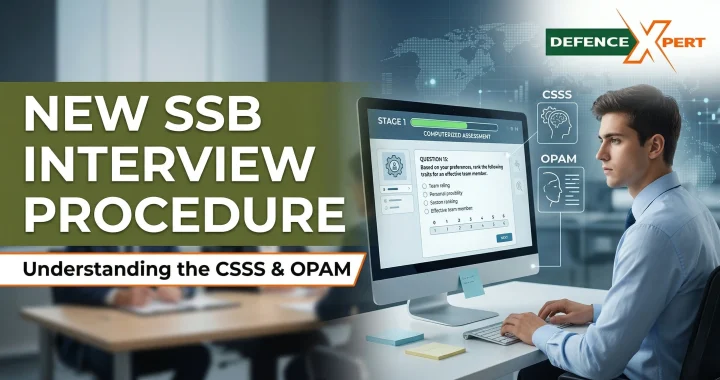
For decades, the Indian Armed Forces have relied on the time-tested 5-day Services Selection Board (SSB) interview to handpick leaders. However, to keep pace with the demands of modern warfare and the cognitive agility required of today’s officers, the selection system is undergoing its most significant overhaul in nearly 30 years. The introduction of the new SSB interview procedure, specifically the Computerized Stage 1 Selection System (CSSS), marks a shift toward a more objective, data-driven, and tech-enabled methodology. If you are an aspirant aiming for the stars and stripes, understanding these changes is the first step toward your “Screened In” stamp.
The Dawn of Digitization: Stage 1 Screening
Traditionally, Day 1 of the SSB involved the Officer Intelligence Rating (OIR) test and the Picture Perception & Discussion Test (PPDT). While effective, these relied heavily on manual evaluation and subjective group dynamics.
The new SSB interview procedure introduces a fully computerized interface on Day 1, consisting of two primary pillars:
1. The Cognitive Battery (CSSS)
This module consists of approximately 70 questions designed to assess higher-order executive functions. Unlike the old OIR, this battery dives deeper into a candidate’s mental architecture, testing:
-
Space Perception and Visualization: Ability to mentally manipulate 2D and 3D objects.
-
Map and Working Memory: Recalling routes and spatial data under pressure.
-
Selective and Sustained Attention: Focusing on critical tasks while filtering out noise.
-
Linguistic and Auditory Discrimination: Processing verbal and sound-based information accurately.
Candidates have expressed that these tests require split-second decision-making, with some problems appearing only for a few seconds .
2. OPAM (Objective Personality Assessment Measure)
Following the cognitive tests, candidates face the OPAM, which consists of roughly 120 self-report items. These are not “right or wrong” questions but are scientifically mapped to evaluate the 15 Officer-Like Qualities (OLQs) . By analyzing behavioral patterns through a digital interface, the board can identify candidates with the highest potential for recommendation in Stage 2.
Why the Change?
The transition to a tech-enabled system isn’t just about modernization; it’s about accuracy.
-
Eliminating Human Bias: Automated scoring ensures every candidate is judged on a level playing field without manual subjectivity.
-
Efficiency: The entire test is completed in a single sitting, saving candidates from moving between multiple testing areas and waiting for results.
-
Selecting “Cognitively Superior” Leaders: Modern battlefields are fast-paced. The new SSB interview procedure filters for those who can function effectively and efficiently in ever-changing scenarios.
Does This Change the Whole 5-Day SSB Process?
A common misconception among aspirants is that the entire interview is becoming a computer test. As per official updates, the computerized system currently only replaces the Stage 1 (Day 1) process. The balance of the 4 days—Psychology Tests, GTO Tasks, and the Personal Interview—remains unchanged .
This means that while the screening is “smarter,” the core evaluation of your personality, courage, and teamwork still happens on the ground and in the interview room.
How to Prepare for the New SSB Interview Procedure
Transitioning to the new SSB interview process requires a shift in your preparation strategy:
-
Sharpen Mental Speed: Since the CSSS is time-sensitive, practice mental math, pattern recognition, and memory-based puzzles.
-
Authenticity in OPAM: Because the system tracks patterns, trying to “fake” a personality can lead to inconsistencies that the algorithm will flag. Be your authentic self.
-
Tech Comfort: While computer skills are not required to take the test, being comfortable with a mouse and keyboard will help you focus on the questions rather than the interface.
Final Thoughts
The SSB is evolving to select leaders who are not just physically fit but cognitively elite. Whether it’s a computer screen on Day 1 or a “command task” on Day 4, the goal remains the same: finding those who put “Nation First.”
Also Read: How to prepare for Group Discussion in SSB Interview
Ans. The CSSS is a modern, tech-enabled screening tool designed to transform the traditional Day 1 screening process. It uses a digital interface to assess a candidate’s cognitive abilities and personality attributes in a more structured, objective, and data-driven manner.
Ans. While the CSSS covers cognitive and personality mapping, it is often seen as a replacement for the OIR test. However, the automated nature of the screening aims to make the “Screening In” process faster and more unbiased than the manual interpretation used in PPDT.
Ans. The new SSB interview process utilizes computerized Stage 1 screening through CSSS and OPAM. It objectively evaluates cognitive skills and personality traits to remove human bias. Days 2-5 remain unchanged.

Pingback: 5 Days SSB Interview Procedure: Day-Wise Breakdown & Expert Tips 2026 - Defence Xpert